
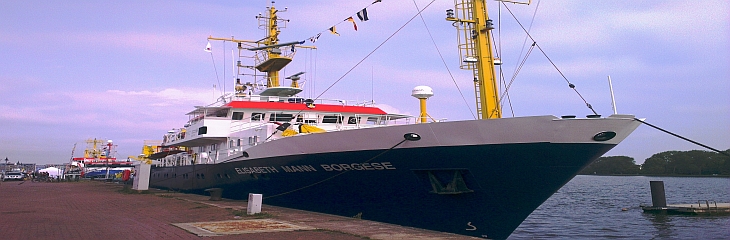
Arbeitsgruppe Biogeochemie Umweltrelevanter Gase
Gelöste Gase spielen aus verschiedenen Gründen eine wichtige Rolle auf dem Gebiet der Meereschemie.
Für die Treibhausgase Methan und Lachgas fungiert die Meeresumwelt als Nettoquelle für die Atmosphäre; für Kohlendioxid ist sie eine starke Senke für vom Menschen verursachte Emissionen. Die Prozesse, die den Kreislauf all dieser Gase steuern, unterliegen Veränderungen, insbesondere in den Küstengewässern, wo die Primärproduktion durch erhöhte Nährstoffbelastungen (Eutrophierung) erhöht wird und der erhöhte Sauerstoffbedarf den Kreislauf von redoxempfindlichen Gasen wie Methan und Lachgas verändert, was widerum Potenzial für unerwünschte Rückkopplungen birgt. Der Kohlenstoffkreislauf ist das wichtigste Bindeglied zwischen der Primärproduktion an der Oberfläche und der internen sauerstoffabhängigen Mineralisierung, und somit der Schlüssel zum Verständnis der Biogeochemie im marinen Bereich.
Andere gelöste Gase, obwohl ökologisch nicht so relevant, können wertvolle Informationen für die Rate wichtiger Prozesse oder Transportmechanismen liefern. Beispiele sind die Verwendung des N2/Ar-Verhältnisses zur Quantifizierung der Stickstofffixierung / Denitrifikation, oder die Verwendung von künstlichen Gas-Tracern zur Beurteilung der vertikalen Mischung oder Belüftung.
Die Arbeitsgruppe Spurengasbiogeochemie ist in allen Forschungsschwerpunkten des Forschungsprogramms des IOW tätig:
- Prozessstudien beleuchten wichtige Schlüsselprozesse zur Regulierung von Spurengasproduktion, -abbau und Transportmechanismen (Forschungsschwerpunkt 1).
- Beckenweite Stoffflüsse und Stoffwechselraten sowie mögliche Veränderungen auf verschiedenen Zeitskalen werden durch kontinuierliche und langfristige Beobachtungen untersucht, insbesondere durch den Einsatz unserer Instrumente auf dem VOS Finnmaid (Forschungsschwerpunkte 2 und 3).
- Durch technische Entwicklungen wollen wir den Weg für eine bessere und kosteneffektive Umweltüberwachung bereiten, die den gesellschaftlichen Bedürfnissen entspricht (Forschungsschwerpunkt 4, Querschnittsaufgabe Innovative Messtechnik).
- Unser Forschungsfeld umfasst die marine Wassersäule sowie die Sediment-Wasser- und Luft-See-Schnittstelle.
Leitung Arbeitsgruppe
wissenschaftlicher Mitarbeiter
wissenschaftliche Mitarbeiterin
wissenschaftlicher Mitarbeiter
Dr. Luiz Cotovicz Jr.
wissenschaftlicher Mitarbeiter
Dr. Teresa Morganti
wissenschaftliche Mitarbeiterin
Dr. Jannine M. Lencina Avila
wissenschaftliche Mitarbeiterin
Dr. Matthias Kreuzburg
wissenschaftlicher Mitarbeiter
technischer Mitarbeiter
Dipl.Ing (FH) Michael Glockzin
technischer Mitarbeiter
Bernd Sadkowiak
technischer Mitarbeiter
Doktorandinnen/
Doktoranden
Sören Iwe
H. M. Kusala M. Premaratne